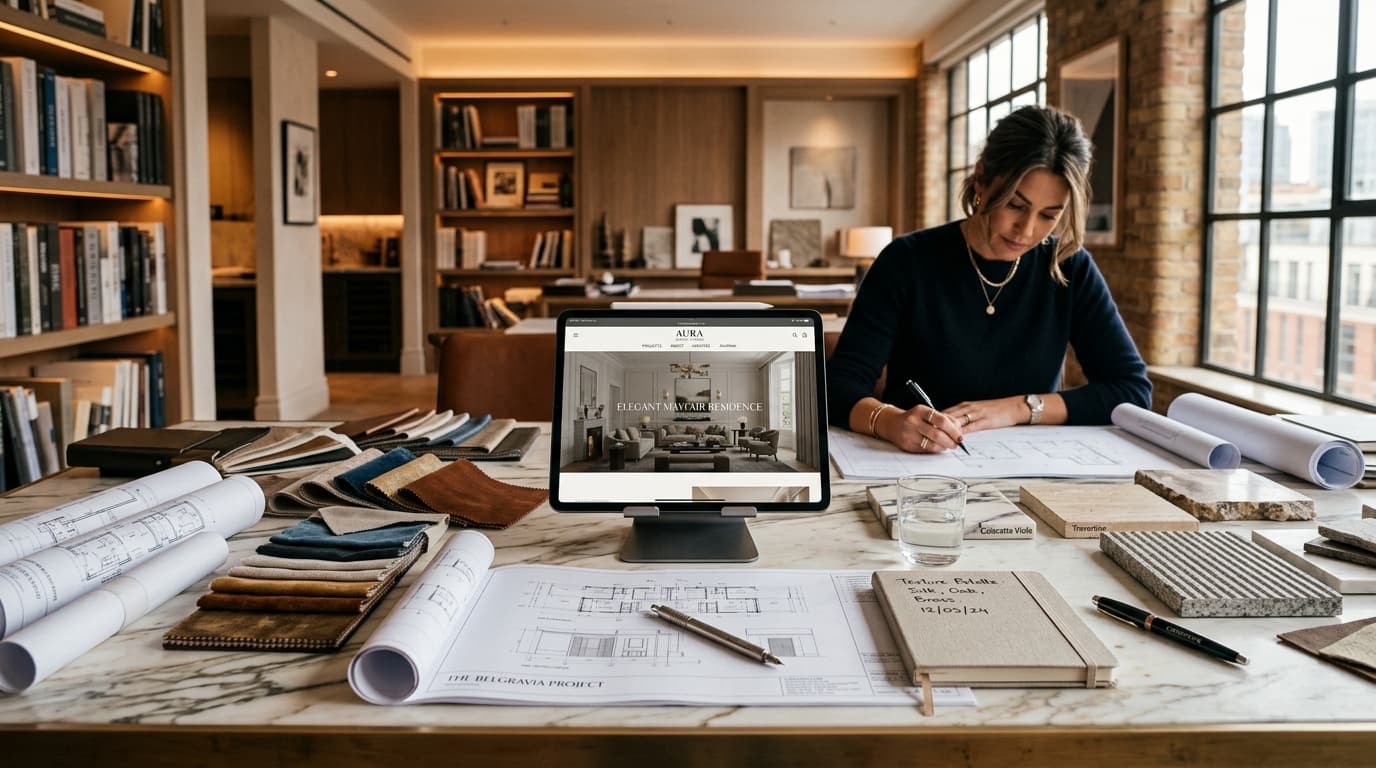
An interior designer's website must combine editorial visual luxury with enterprise technical speed, room-level project taxonomies, and low-friction consultation pathways to convert affluent homeowners into signed contracts.
For an interior design practice, a website is far more than an online brochure; it is your digital flagship showroom. When an affluent client considers spending ₹20 Lakh to over ₹1 Crore on a complete residential transformation, turnkey penthouse overhaul, or commercial fit-out, their evaluation begins long before they visit your studio. They judge your craftsmanship, aesthetic restraint, attention to detail, and professional reliability through your digital presence.
Yet many design studio websites actively repel prospective clients. Heavy, uncompressed photo galleries cause pages to stall on mobile devices. Vague navigation forces visitors to guess what services the studio actually delivers. Generic contact forms ask for tedious paperwork before a client even knows if the studio is available.
Understanding the non-negotiable architectural and structural must-haves transforms an interior design website from a passive portfolio into a consistent client acquisition engine.
(This guide is part of our dedicated interior design cluster. For full search architecture, explore our pillar guide on SEO for interior designers, review our breakdown of SEO keywords for interior designers, and see how to optimize your Google Business Profile for interior designers.)
Must-Have 1: Sub-Second Mobile Speed and Modern Image Compression
High-resolution portfolio photography must be optimized with modern WebP or AVIF compression to pass Google's Core Web Vitals without losing visual clarity.
Interior designers naturally want to showcase their work in the highest visual fidelity possible. However, uploading uncompressed 15MB camera originals directly to a website cripples performance. On mobile networks, heavy pages take six to ten seconds to load, triggering immediate visitor bounce-offs and severe Google search ranking penalties.
A professional interior design website must achieve sub-second loading speeds through modern engineering:
- WebP & AVIF Formats: Converting JPEG and PNG files to modern WebP or AVIF containers reduces file sizes by 40% to 75% without perceptible loss of color accuracy, texture sharpness, or material warmth.
- Responsive Image Sizing: Serving appropriately scaled image dimensions based on the visitor's device prevents mobile smartphones from downloading 4K desktop graphics.
- Core Web Vitals Compliance: Ensuring Largest Contentful Paint (LCP) renders under 2.5 seconds and Cumulative Layout Shift (CLS) remains near zero ensures smooth, stable browsing as visitors swipe through galleries.
Speed is an aesthetic statement: a website that snaps into view instantly signals technical competence and respect for the client's time.
Must-Have 2: Dedicated Room and Service Taxonomies
Structuring distinct landing pages for specific room categories and service models captures high-intent searches that generic homepage galleries miss.
A common design studio mistake is bundling every past project into a single endless gallery page labeled "Work." While aesthetically minimal, this structure fails from both user experience and search engine optimization perspectives.
Prospective clients rarely search for generic portfolios; they search with specific spatial intentions:
- A homeowner whose kitchen is dysfunctional searches specifically for luxury modular kitchen specialists.
- A commercial developer searches for corporate workplace and executive suite design.
- A flat owner searches for complete turnkey residential planning for a 3BHK or duplex apartment.
Essential Page Architecture for Design Studios:
- Core Service Pages: Dedicated pages detailing execution models (e.g., Turnkey Design & Build, Residential Interior Architecture, Bespoke Joinery & Styling).
- Room-Level Landing Pages: Dedicated hubs highlighting specific spatial capabilities (Luxury Living Rooms, Master Bedroom Suites, Modular Kitchens, Spa Bathrooms).
- Regional Location Hubs: Clear geographic pages identifying your primary operating territory (such as South Mumbai, Bandra, or regional metro corridors).
Structuring your website around these clear taxonomies allows search engines to match client queries to exact, relevant destination pages.
Must-Have 3: High-Intent Keyword Alignment and Semantic Structure
Every key page on your website must incorporate structured heading hierarchies and semantic keyword targeting that align with commercial client queries.
Search engines index web pages based on textual content and semantic relationships, not rendered pixels alone. Silent image galleries containing zero descriptive copy cannot rank for competitive commercial terms.
A high-converting website integrates search architecture seamlessly into its design layout:
- Single Meaningful H1 Tag: Each page must feature exactly one primary H1 heading defining its purpose (e.g., "Luxury Residential Interior Design in South Mumbai").
- Semantic Subheadings (H2 & H3): Break down spatial challenges, material selection criteria, and architectural phases with logical subheading structures.
- Descriptive Image Alt Text: Every portfolio photograph should carry descriptive alt text explaining room orientation, finishes, and location (e.g.,
alt="Contemporary open-plan living room with Italian travertine flooring and bespoke fluted oak paneling in Worli penthouse").
(For a comprehensive list of target terms to integrate across your service pages, consult our guide on SEO keywords for interior designers.)
Must-Have 4: Low-Friction Inquiries via Direct WhatsApp Integration
Replacing multi-field inquiry forms with instant WhatsApp communication channels reduces friction and dramatically increases consultation booking rates.
High-net-worth homeowners and commercial property executives browse design portfolios on mobile devices during evening hours or weekend downtime. Forcing these prospective clients to complete an eight-field corporate contact form asking for exact square footages, budget dropdowns, and architectural drawings creates unnecessary friction.
Integrating a prominent, direct WhatsApp consultation button offers clear operational advantages:
- Instant Media Sharing: Clients can immediately photograph their existing room or forward architectural CAD floorplans directly from their mobile phone.
- Immediate Rapport: A quick, professional response from studio leadership establishes immediate warmth and responsiveness.
- Higher Conversion Velocity: Informal initial conversations transition into scheduled on-site walkthroughs far faster than formal email correspondence.
A modern interior design website should offer both: a streamlined, accessible contact form for detailed inquiries and an instant WhatsApp pathway for immediate project consultations.
Must-Have 5: Transparent Process and Investment Guidance
Clearly outlining your studio's design phases and pricing philosophy filters out unqualified inquiries while building confidence with serious clients.
Many design studio websites obscure their process and pricing entirely, fearing that discussing costs will intimidate visitors. In reality, ambiguity creates distrust. Affluent clients want to know what working with your studio entails, who manages on-site execution, and how project fees are structured.
Your website should feature:
- A Phased Design Roadmap: Clearly delineate your workflow: Phase 1: Discovery & Moodboarding ➔ Phase 2: 3D Visualization & Material Selection ➔ Phase 3: Procurement & Vendor Coordination ➔ Phase 4: Turnkey Execution & Handover.
- Clear Fee Structure Explanations: Explain whether your studio charges design-only fees, percentage-of-cost fees, or square-foot turnkey retainers.
- Starting Investment Baselines: Stating that projects or retainers start from a clear baseline (for example, monthly search retainers at Amfor Studio start from ₹15,000/month, with project scopes tailored after audit) sets transparent expectations.
Demystifying the process positions your studio as an organized, mature professional consultancy.
(For a comprehensive breakdown of search marketing costs and investment models, read our analysis on SEO pricing for interior designers.)
Must-Have 6: Structured Schema Markup and Local Trust Signals
Implementing JSON-LD schema markup and visible local credentials communicates geographic relevance and authority directly to search engines.
Search engine algorithms rely on structured data markup to understand the entities, physical locations, and credentials associated with your business. Without schema, Google must guess your operating hours, service-area boundaries, and official studio address.
Critical Schema and Trust Elements:
- LocalBusiness & Service Schema: Embed structured code defining your official business name, registered address, telephone contact, operating hours, and primary service lines.
- Google Map & Location Signals: Clearly display your service areas, whether operating from a physical design showroom or a private creative workshop registered as a Service-Area Business (SAB).
- Verified Client Reviews: Incorporate authentic project testimonials that mention specific neighborhoods and project scopes, reinforcing your local relevance.
(To master geographic signals and map visibility, explore our step-by-step tutorial on local SEO for interior designers.)
10-Point Interior Design Website Audit Checklist
Use this practical checklist to evaluate whether your studio's website possesses the structural foundations required to compete in luxury design markets:
| Feature / Element | Standard Expectation | Strategic Impact on Design Studio |
|---|---|---|
| 1. Mobile Page Load Speed | Under 1.5 seconds on mobile 4G/5G | Prevents visitor abandonment; passes Google Core Web Vitals |
| 2. Modern Image Containers | WebP or AVIF format with lazy loading | Delivers full visual sharpness at a fraction of JPEG file sizes |
| 3. Dedicated Room Pages | Separate URLs for kitchens, master suites, living areas | Ranks for high-intent room searches; guides visitor focus |
| 4. Direct WhatsApp Channel | One-tap floating WhatsApp consultation button | Allows clients to share floorplans and request site visits instantly |
| 5. Single Structured H1 | Clear primary service and location keyword in H1 | Establishes unambiguous topical relevance for search crawlers |
| 6. Written Case Study Copy | 300–500 words of authentic narrative per project | Provides semantic context explaining challenges and materials |
| 7. Design Process Overview | Step-by-step explanation of design and build phases | Demystifies execution and reassures prospective clients |
| 8. Investment Transparency | Clear explanation of fee models and engagement baselines | Pre-qualifies budgets and filters out price-shopping inquiries |
| 9. Structured Schema Code | Valid JSON-LD LocalBusiness and Service markup |
Enables rich snippets and reinforces local Google knowledge graph |
| 10. Responsive Clean Layout | Zero clutter, elegant typography, intuitive navigation | Reflects the refined aesthetic standard of your physical spaces |
Frequently Asked Questions
What platform is best for an interior designer website?
Modern custom web engineering (such as Next.js with React) delivers the highest performance, sub-second speeds, and complete design freedom without plugin bloat. For non-custom setups, platforms that prioritize visual typography and image optimization are preferable to slow, generic templates.
How many portfolio projects should an interior designer display?
Quality matters far more than quantity. Curate 6 to 12 exceptional, fully documented project case studies that represent the exact scale and aesthetic caliber of work you want to attract, rather than displaying dozens of minor or outdated projects.
Should an interior designer display pricing on their website?
While quoting exact turnkey budgets on a public website is difficult due to material and structural variability, providing clear starting baselines and explaining your fee structure (e.g., design fees vs. turnkey execution) builds immediate trust and filters out unqualified inquiries.
How can an interior designer make high-resolution photos load quickly?
Convert all photography to the modern WebP or AVIF format, compress files to keep individual images under 250KB, implement responsive picture elements for mobile screens, and utilize a global content delivery network (CDN) to serve assets from servers closest to the user.
Why is WhatsApp integration important for interior designers?
Interior design is a collaborative, visual service. WhatsApp enables clients on mobile devices to bypass long forms and immediately share room photos, floorplans, and site availability directly with studio leadership, dramatically shortening the consultation booking cycle.
Build a World-Class Digital Flagship with Amfor Studio
Amfor Studio designs and engineers bespoke digital platforms, custom websites, and authoritative search strategies for luxury interior design studios, architectural firms, and high-end spatial creators.
- Explore our specialized Web Design & SEO for Interior Designers
- Review our dedicated Interior Designer Website & Local SEO Case Study
- Read our foundational cluster pillar: SEO for Interior Designers
- Understand target keywords with our guide on SEO Keywords for Interior Designers
- Review investment expectations: SEO Pricing for Interior Designers
- Master geographic search with our Local SEO for Interior Designers Guide
- Master visual project optimization: Portfolio SEO for Interior Designers
- Consult with our search engineering team: SEO Company in Mumbai and Local SEO Services
Ready to elevate your studio's website into a high-converting digital showroom? Connect directly with our team on WhatsApp to discuss your website's technical architecture and design requirements.