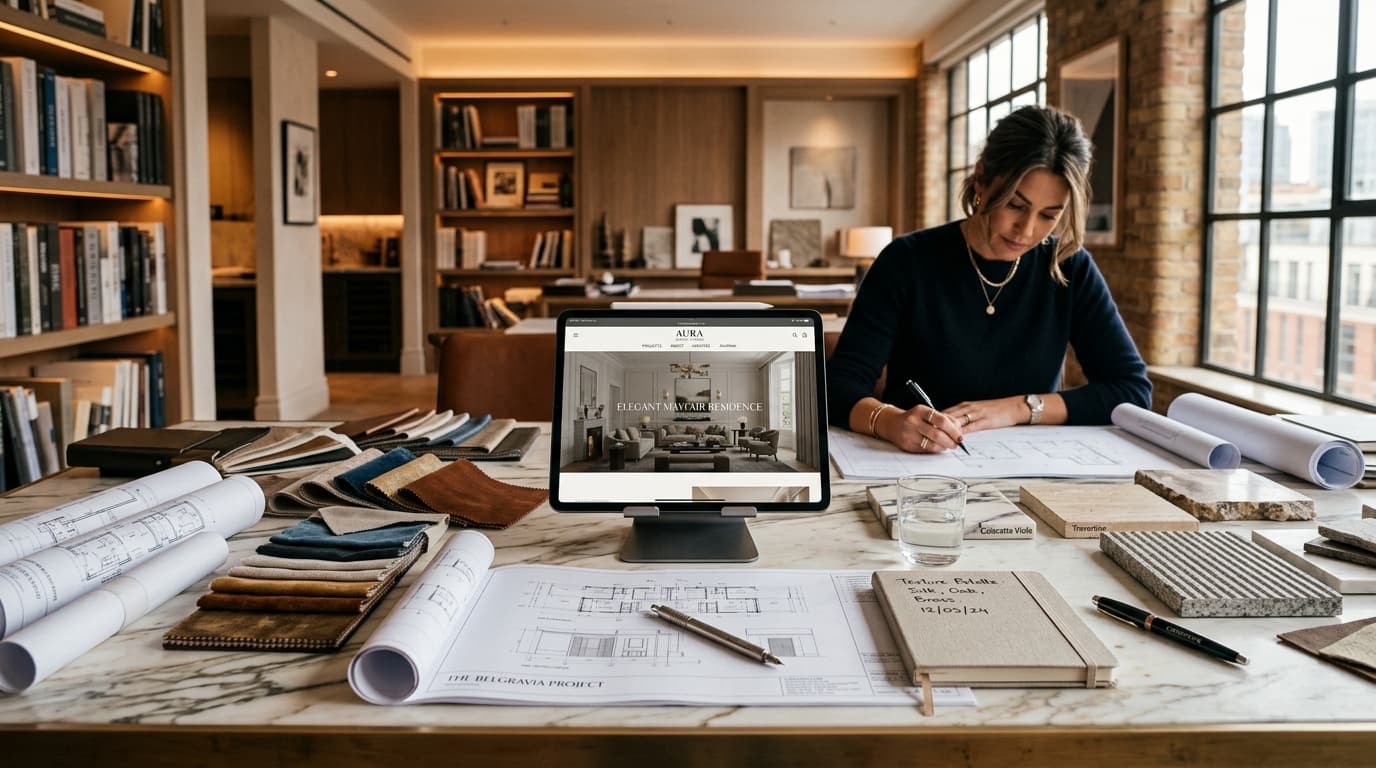
Local SEO for interior designers is the strategic process of optimizing your studio's Google Business Profile, localized portfolio pages, and geographic search signals so that nearby homeowners and commercial clients discover your practice when seeking bespoke interior design, turnkey renovations, and specialized spatial styling.
While broad online visibility can drive casual visual browsing, interior design is inherently a location-grounded profession. High-value commissions—whether a luxury residential overhaul in an affluent neighborhood or a turnkey corporate office fit-out—require site visits, material sample curation, structural space planning, and regular coordination with local contractors and craftsmen. A homeowner preparing to invest in an extensive residential redesign will not hire a studio based purely on generic social media aesthetics; they search for proven design talent within their immediate metropolitan area who understands regional architectural styles, residential building regulations, and local sourcing networks.
Executing a disciplined local search strategy ensures that when prospective clients in your target neighborhoods search for specialized design expertise, your studio appears prominently across both Google Maps and organic search results.
(For a broader overview of technical foundations and search architecture, read our foundational guide on SEO for interior designers, or explore our transparent breakdown of SEO pricing for interior designers.)
Why Local Search Intent Is Distinct for Interior Design Practices
Unlike standard retail or consumer services, prospective interior design clients search using highly specific room types, spatial requirements, and aesthetic preferences rather than simple generic keywords.
When homeowners begin planning a home transformation, their search behavior typically begins with specific pain points or aspirations before broadening into a search for a full-service firm. Understanding these behavioral patterns is essential for structuring a website that captures search intent early in the decision-making cycle.
Interior design search intent operates across distinct local dimensions:
- Room-Type and Scope Queries: Rather than searching only for "interior designer near me," prospective clients frequently query specific spatial projects: "luxury modular kitchen designer South Mumbai", "master bedroom interior decorator Worli", or "walk-in wardrobe space planning".
- Project-Type and Scale Intent: Clients with substantial budgets search by property scale and execution scope: "turnkey interior designer for 3BHK flat", "duplex penthouse interior renovation", or "commercial boutique studio interior styling".
- Aesthetic and Material Affinity: Discerning clients often pair local intent with design vocabulary: "minimalist interior designer", "contemporary biophilic apartment interiors", or "custom teak wood interior design".
- Physical Proximity and Site Access: Clients require reassurance that your studio has hands-on availability for regular site inspections, structural coordination meetings, and vendor oversight.
Focusing your local SEO solely on generic phrases like "interior designer" ignores the vast majority of high-intent queries that affluent homeowners use when they are ready to commission a project.
Local Landing Page Architecture: Bridging Room Types and Target Localities
To capture high-intent local searches across different neighborhoods, your website needs dedicated landing page architectures that unite specific room-level capabilities with geographical service areas.
A single homepage cannot adequately rank for every room specialty and geographic micro-market your studio serves. If your practice operates across multiple premium districts—such as heritage properties in South Mumbai alongside contemporary suburban high-rises—your search architecture must reflect those distinct service zones.
Principles for Structuring Local Service Pages:
- Avoid Generic Location Clones: Creating dozens of nearly identical pages where only the city or neighborhood name is swapped creates duplicate content issues that undermine domain authority. Every localized page must present genuine project context, such as typical residential floorplans in that district, common architectural constraints, or past client case studies.
- Dedicated Room-Category Pages: Build focused service pages for your primary revenue drivers—such as full-home turnkey transformations, bespoke kitchen design, and luxury bathroom remodeling. Connect these service pages to relevant project case studies set in your primary localities.
- Structured Schema Markup: Implement structured
LocalBusinessandServiceschema across your location pages to clearly communicate your geographic boundaries, studio hours, and service categories to search engines. - Integrated Internal Linking: Connect your localized service hubs directly with detailed portfolio case studies and your primary local SEO services infrastructure to facilitate crawl efficiency and distribute authority throughout your site.
Optimizing Portfolio Photography for Local Search Signals
Because interior design is evaluated visually, portfolio photography must be optimized with geo-contextual metadata and descriptive room tags rather than presented as silent image galleries.
Search engine bots cannot see the craftsmanship of a fluted marble kitchen island or custom oak paneling unless you provide structured textual context. Uncaptioned portfolio galleries containing default camera filenames (such as IMG_4021.jpg) represent missed ranking opportunities for valuable local queries.
Camera Filename (IMG_4021.jpg) ➔ Descriptive Localized Slug (worli-penthouse-modular-kitchen.webp) ➔ Room-Specific Alt Text ➔ Contextual Project Narrative ➔ Local Image Ranking
Steps to Localize Your Visual Assets:
- Descriptive, Contextual File Names: Name your image files to reflect both the room type and the project locality (e.g.,
south-mumbai-master-suite-interior.webporworli-sea-facing-living-room.webp). - Descriptive Alt Text: Write alt text that accurately describes the spatial elements, finishes, and context (e.g., "Custom Italian marble vanity and brushed brass fixtures in a South Mumbai luxury apartment").
- Room-by-Room Narrative Context: Surrounding your images with 300 to 500 words of authentic project narrative explaining the design challenge, layout solutions, and material selections provides the semantic context search engines require to index the page for relevant local searches.
- Compression and Core Web Vitals: High-resolution galleries must be converted to modern formats such as WebP or AVIF and compressed to load in under one second on mobile networks. Slow portfolio pages cause immediate drop-offs among mobile visitors and negatively impact search rankings.
Multi-Platform Local Authority: Houzz, Pinterest, and Consistent Citations
In the interior design sector, local search authority extends beyond Google to visual discovery platforms like Houzz and Pinterest, which provide powerful local entity signals.
Affluent homeowners rarely rely on a single platform when selecting an interior designer. They often browse design concepts on Pinterest, research local studio credentials on Houzz, and confirm physical legitimacy through Google Maps. Maintaining strict consistency across all three channels reinforces your studio's authority in Google's local knowledge graph.
| Platform | Primary Discovery Function | Key Optimization Requirement for Design Studios |
|---|---|---|
| Google Business Profile | Local 3-Pack and direct map routing | Verified categories, service areas, high-res project photos, client reviews |
| Houzz Pro Directory | Local directory ranking and homeowner research | Complete project albums, verified client testimonials, matching business details |
| Pinterest Business | Visual search and aesthetic discovery | Geo-tagged project boards, rich pins linking to portfolio case studies |
| Design Directories & Press | Domain authority and regional credibility | Editorial features, design council listings, architectural directory profiles |
Ensure your studio's Name, Address, and Phone number (NAP) are identical across all directories. Discrepancies in your studio name, phone number, or physical suite address can fragment your local citation profile and diminish your ranking stability in the Local 3-Pack.
Google Business Profile: Studio Showroom vs. Service-Area Business (SAB)
Configuring your Google Business Profile correctly depends on whether you operate a public design showroom or provide on-site consultations across defined residential corridors.
One of the most common dilemmas for boutique interior designers is how to manage their physical business address. Some studios maintain a public design studio or material library where clients meet for consultations. Others work from private creative spaces or manage projects primarily on construction sites and at client properties.
Choosing Your Profile Model:
- Physical Studio Showroom: If you maintain a commercial studio, material showroom, or dedicated office with clear exterior signage and regular consultation hours, displaying your physical address helps build immediate local trust and allows nearby clients to request driving directions.
- Service-Area Business (SAB): If you operate from a private residence or non-public design workshop, Google's guidelines require you to hide your physical street address and designate specific service areas (by city, region, or postal code). This protects personal privacy while still allowing your profile to rank in the Local 3-Pack within your designated operating territory.
Critical Google Business Profile Best Practices:
- Select Accurate Categories: Set your primary category to Interior Designer. Select relevant secondary categories such as Interior Decorator, Kitchen Remodeler, or Bathroom Remodeler if your practice offers turnkey contracting and execution services.
- Curate High-Resolution Visuals Regularly: Upload professional photographs of completed projects, material samples, and on-site execution on a monthly basis. Google prioritizes active profiles that consistently publish authentic, geo-relevant media.
- Structured Review Generation: Request reviews from past clients that specifically mention the project type and location (e.g., "Amfor Studio transformed our 3BHK apartment in South Mumbai with exceptional turnkey attention to detail"). Natural inclusion of service and location keywords in client reviews strongly supports local ranking prominence.
Streamlining Inquiries: Direct WhatsApp Consultation Pathways
For luxury and high-touch interior design practices, replacing lengthy inquiry forms with direct WhatsApp communication significantly reduces friction for prospective local clients.
Affluent homeowners researching interior designers on mobile devices often find extensive multi-field forms cumbersome. When a client discovers an inspiring living room project in your portfolio, they often want to inquire immediately about feasibility, consultation scheduling, or preliminary site assessments.
Integrating direct WhatsApp links allows prospective clients to:
- Instantly share floorplans, architectural blueprints, or existing room photographs.
- Ask preliminary questions about your studio's project scope and availability.
- Schedule an initial on-site discovery walkthrough with minimal administrative delay.
Ensuring your local landing pages, portfolio case studies, and Google Business Profile incorporate clear, direct messaging pathways ensures that the local traffic you generate converts into qualified consultation dialogues.
Frequently Asked Questions
How long does it take for an interior designer to rank in the Google Local 3-Pack?
Securing a position in the Google Local 3-Pack generally takes between three to six months of consistent optimization. Timing depends on local market density, the existing authority of your domain, the completeness of your Google Business Profile, and the steady acquisition of authentic client reviews.
Should an interior designer display a home office address on Google Maps?
If you operate from a home studio without public signage or walk-in consultation hours, you should configure your profile as a Service-Area Business. This hides your street address while defining the specific cities or postal codes your practice serves, fully complying with Google's guidelines while maintaining your local search visibility.
What are the most important primary and secondary categories for an interior design studio?
Your primary category should almost always be "Interior Designer." Depending on the scope of your services, secondary categories may include "Interior Decorator," "Bathroom Remodeler," "Kitchen Remodeler," or "Architectural Designer." Avoid adding unrelated categories that do not reflect your core design services.
How do room-type searches impact local interior design rankings?
Homeowners frequently search for solutions to specific rooms (such as custom kitchens or master bedrooms) before committing to a full-home renovation. Creating dedicated service pages and portfolio case studies for distinct room types allows your studio to capture these high-intent local queries that competitors targeting only generic terms miss.
Can an interior designer rank in multiple cities or neighborhoods?
Yes, an interior design practice can rank across multiple localities by developing authentic, individualized location landing pages and defining broad service areas in their Google Business Profile. Each localized page must feature genuine regional project context rather than duplicated boilerplate text.
Partner with Amfor Studio to Lead Your Local Design Market
Amfor Studio crafts high-performance digital architectures, bespoke websites, and localized search positioning for premier interior design practices, architectural studios, and luxury spatial brands.
- Explore our specialized Web Design & SEO for Interior Designers
- Review our dedicated Interior Designer Website & Local SEO Case Study
- Read our foundational guide: SEO for Interior Designers
- Understand investment models with our SEO Pricing for Interior Designers guide
- Connect with our local strategy specialists: SEO Company in Mumbai and Local SEO Services
Ready to make your studio the preferred choice for premier residential and commercial projects in your target areas? Connect directly with our team on WhatsApp to discuss your practice's local search positioning.