
Most interior designers don't struggle because of bad design they struggle because Google doesn't understand their websites. A beautiful portfolio alone isn't enough to rank. This guide explains why and shows you exactly how to fix it.
- ›1. SEO for Interior Designers: The Core Paradox
- ›2. Insights from 30 SEO Audits in 30 Days
- ›3. Interior Design Website Architecture
- ›4. How Google Crawls & Indexes Design Sites
- ›5. Website Speed & Core Web Vitals
- ›6. Technical SEO Master Checklist
- ›7. Local SEO & Location Landing Pages
- ›8. Google Business Profile Optimization
- ›9. Image SEO & Portfolio Asset Checklist
- ›10. AI Search Optimization (Perplexity & AI Overviews)
- ›11. 30-Day SEO Action Plan for Interior Designers
- ›12. Monthly SEO Maintenance Checklist
- ›13. Case Study: 12/100 to 92/100 SEO Transformation
- ›14. Website Platform Benchmark (Next.js vs WP)
- ›15. Organic SEO vs Paid Social Ads (ROI)
- ›16. Content Publishing Strategy & Keyword Mapping
- ›17. Partnering with a Specialized Technical Agency
- ›18. Frequently Asked Questions
1. SEO for Interior Designers: The Core Paradox
Human clients appreciate visual elegance; Googlebot requires structural, technical, and semantic signals.
A visually stunning portfolio website impresses human visitors once they arrive. However, search engines like Google cannot admire marble finishes, custom lighting, or tailored upholstery unless those details are communicated through structured data, clean code, and explanatory copy.
When prospective clients search for an interior designer, Google scans thousands of web pages in milliseconds. If your website lacks explanatory editorial text, semantic HTML markup, proper site hierarchy, and explicit keyword targeting, Google cannot determine what spatial design services you offer or where your studio operates.
Investing strictly in visual branding without establishing search engine infrastructure guarantees your website remains invisible to prospective high-net-worth clients searching online every day.
Every project page in your portfolio should target ONE specific location and design style keyword (e.g., 'Modern Apartment Interior Design Mumbai', 'Luxury Villa Interior Design Pune', or 'Commercial Office Fitout Bangalore') rather than generic terms.
2. Insights from 30 SEO Audits in 30 Days
Empirical research revealing why top interior design studios remain invisible on search engines.
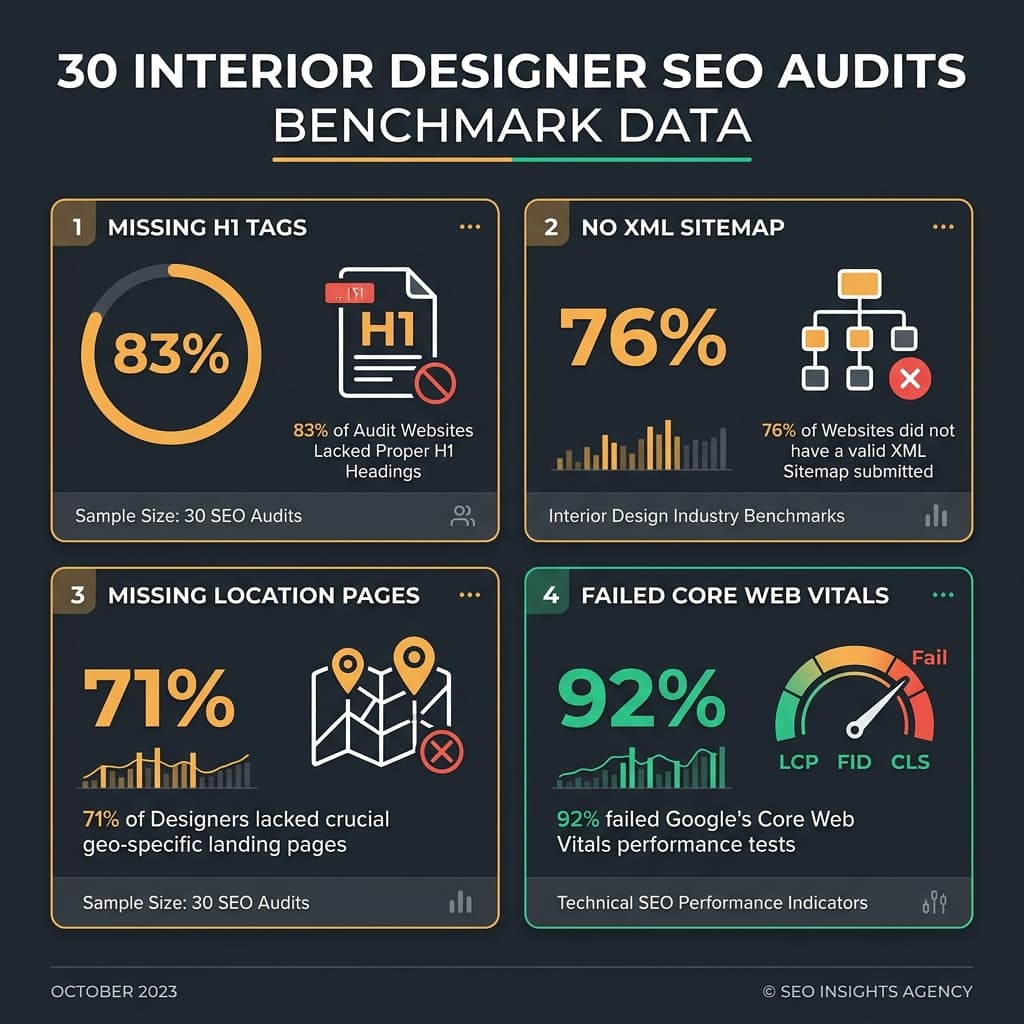
Over the past 30 days, we conducted in-depth technical SEO audits on 30 interior design and architecture studio websites across major metropolitan markets. What we uncovered was eye-opening: the vast majority of firms suffer from identical structural vulnerabilities.
These deficits were not isolated incidents they appeared consistently across minimalist agency sites, boutique studio platforms, and luxury architectural portfolios alike.
3. Interior Design Website Architecture
Why full-screen photo carousels without editorial context hurt search rankings.
The single biggest mistake in interior design web development is building full-screen photo carousels with zero written editorial content. A project page containing 20 photos but only 15 words of text signals to Google that the page is 'thin content'.
To rank effectively, an interior design website requires dedicated landing pages for each core service (e.g., Residential Interiors, Commercial Interiors, Turnkey Fitouts, Architecture), detailed case studies for individual projects, and dedicated location landing pages.
Structuring your site logically with clear internal links ensures search engine crawlers can index every page while delivering an intuitive user experience for human visitors.
4. How Google Crawls & Indexes an Interior Design Website
From raw HTML parsing to DOM rendering and index inclusion.
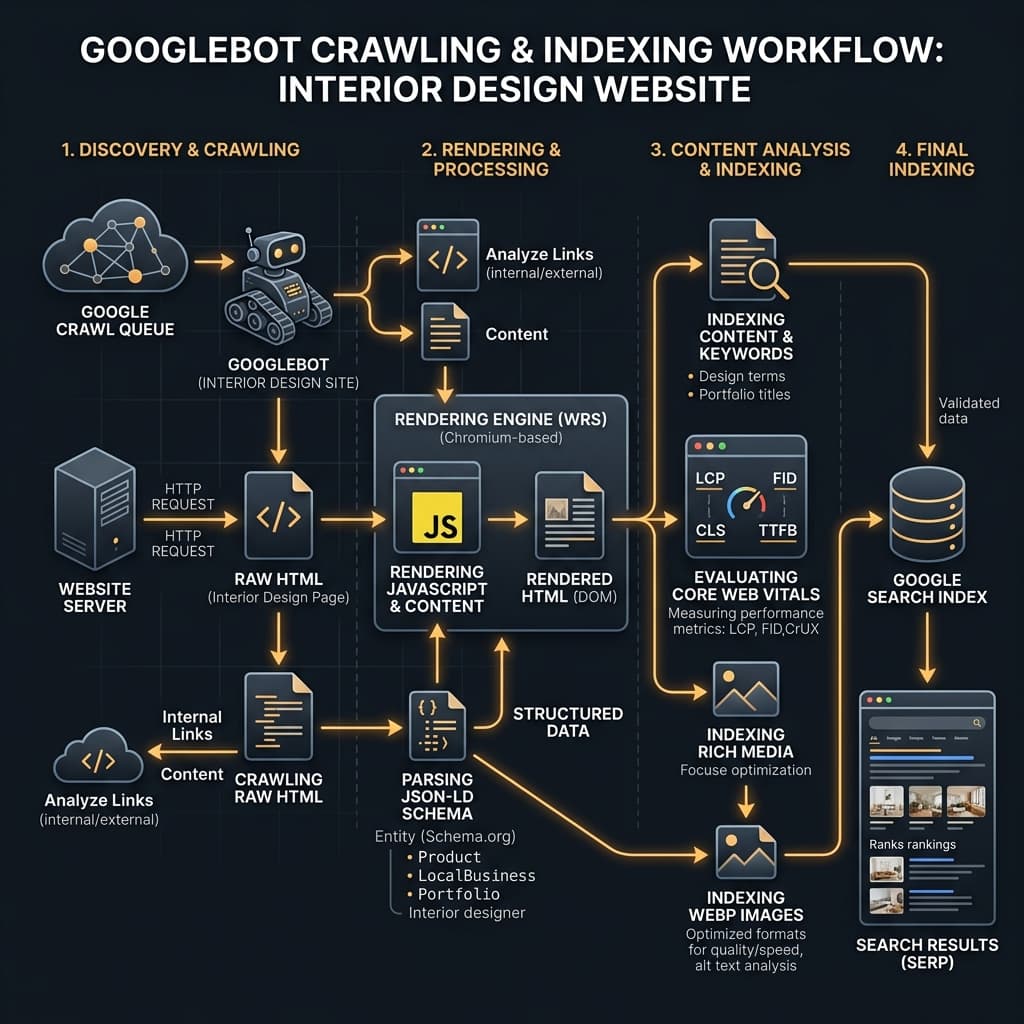
To optimize your website effectively, you must understand how Googlebot processes web pages. The process involves three distinct phases: Crawling, Rendering, and Indexing.
During Crawling, Googlebot fetches the HTML code of your website. During Rendering, it processes JavaScript and visual layout files. Finally, during Indexing, Google analyzes text content, images, and schema metadata to decide where your page should rank in search results.
If your website relies on heavy client-side JavaScript rendering or hides key text behind unindexed carousels, Googlebot may fail to parse your core service offerings.
5. Website Speed & Core Web Vitals
Largest Contentful Paint (LCP), Interaction to Next Paint (INP), and Cumulative Layout Shift (CLS).
High-resolution uncompressed photography often causes portfolio websites to weigh over 25MB. Over mobile networks, these pages take 6 to 10 seconds to render.
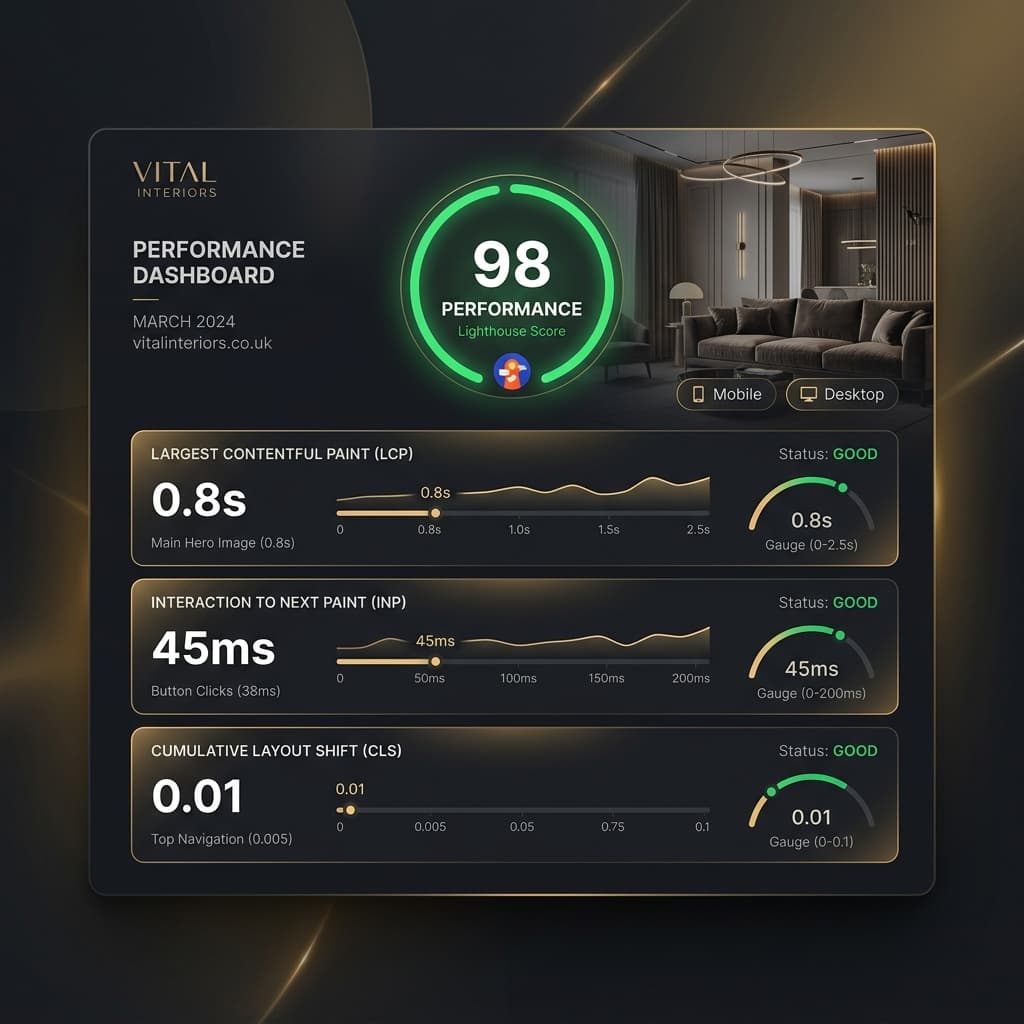
Google explicitly penalizes slow-loading websites via Core Web Vitals ranking signals. Largest Contentful Paint (LCP) measures how fast the main hero image loads (should be under 2.5s). Interaction to Next Paint (INP) measures responsiveness (under 200ms).
Optimizing website speed by converting images to WebP format, implementing responsive image sizing, and using edge CDN hosting directly boosts search engine rankings.
6. Technical SEO Master Checklist
Clean DOM structure, XML sitemaps, canonicalization, and security headers.
Technical SEO ensures search engine crawlers can index every page on your domain without encountering technical roadblocks or broken links.
📋Technical SEO Checklist for Interior Studios
- ✓Ensure exactly ONE H1 tag per page containing your primary keyword.
- ✓Generate and submit a dynamically updating XML Sitemap via Google Search Console.
- ✓Implement canonical tags on all pages to prevent duplicate content issues.
- ✓Enforce HTTPS encryption with HSTS security headers across all endpoints.
- ✓Maintain clean semantic HTML5 markup (main, header, section, footer, article).
- ✓Fix all 404 broken links and properly configure 301 redirects for legacy URLs.
7. Local SEO & Location Landing Pages
Capturing high-intent search queries in your city and target service areas.
Interior design is inherently a location-based business. High-net-worth clients search specifically for 'luxury villa interior designer in South Mumbai', 'residential interior designer Gurgaon', or 'office interior designer Bangalore'.
Creating dedicated location landing pages for each city or neighborhood you serve allows your studio to capture localized search traffic with high conversion intent.
Each location page should contain localized editorial copy, geotagged project case studies, embedded client testimonials from that city, and LocalBusiness Schema markup.
📋Location Landing Page Checklist
- ✓Create unique location URLs (e.g. /interior-designer-mumbai).
- ✓Include localized headings targeting city and landmark terms.
- ✓Embed structured Schema.org LocalBusiness & InteriorDesignStudio JSON-LD.
- ✓Highlight local project case studies and client feedback from that market.
8. Google Business Profile Optimization
Dominating the Google Local Map Pack and local search results.
Appearing in Google's Local Map Pack generates immediate phone calls and client audit requests. Optimizing your Google Business Profile (GBP) is critical for local discovery.
Ensure 100% NAP (Name, Address, Phone) consistency across your website, Google Business Profile, and third-party directories like Houzz and ArchDaily.
Regularly upload high-resolution, geotagged project photos to your GBP listing and proactively collect keyword-rich reviews from satisfied clients.
9. Image SEO & Portfolio Asset Checklist
Maximizing visibility in Google Image Search while keeping site speed sub-second.
High-net-worth clients frequently use Google Image Search to source interior design inspiration before hiring a studio.
Image file names like IMG_9042.jpg provide zero context to Google. Renaming files to luxury-penthouse-living-room-interior-mumbai.webp and adding descriptive alt attributes ensures your images appear in image search results.
📋Complete Image SEO Checklist
- ✓Convert all portfolio photos to WebP or AVIF format for up to 80% file size reduction.
- ✓Rename raw photo files to include descriptive keyword & location terms.
- ✓Add descriptive alt text to every image describing room style, materials, and city.
- ✓Implement responsive image sizing (srcset) to serve smaller images to mobile devices.
- ✓Enable native browser lazy loading (loading='lazy') for below-the-fold project photos.
- ✓Specify explicit width and height attributes on img tags to prevent layout shifts (CLS).
10. AI Search Optimization (Perplexity & AI Overviews)
Optimizing your studio for Generative Engine Optimization (GEO), SearchGPT, and Google AI Overviews.
Search behavior is evolving rapidly. Affluent homeowners increasingly ask AI search engines like Perplexity, ChatGPT Search, and Google AI Overviews questions like: 'Who are the top luxury interior designers in Mumbai known for minimalist residential projects?'
To appear in AI-generated answers, your website must demonstrate Generative Engine Optimization (GEO). AI engines synthesize information from authoritative brand mentions, structured Schema.org data, comprehensive project narratives, and clear digital press citations.
Publishing detailed case studies, maintaining consistent press features, and structuring your copy in direct Q&A formats ensures AI search engines cite your studio as a category leader.
AI search engines prioritize sites with strong E-E-A-T signals, structured JSON-LD schema, clear subheadings, and empirical data. Publishing original project specifications makes your site a preferred source for AI summaries.
11. 30-Day SEO Action Plan for Interior Designers
Step-by-step roadmap to fix technical bottlenecks and start growing search rankings.
Transforming your studio website into a high-performing organic search engine requires a structured execution roadmap.
Technical Audit & Speed Optimization
- ›Audit DOM structure & ensure single H1 per page
- ›Compress all project images to WebP format
- ›Implement LocalBusiness JSON-LD Schema markup
- ›Generate XML sitemap & submit to Google Search Console
Location Pages & Image Metadata
- ›Build 3+ dedicated location landing pages
- ›Update all portfolio image filenames & alt tags
- ›Verify Google Business Profile NAP consistency
- ›Construct internal linking between projects & services
Content Engine & Review Pipeline
- ›Publish 2 comprehensive project case studies
- ›Launch review request workflow for recent clients
- ›Build citations on design platforms (Houzz, ArchDaily)
- ›Monitor GSC query impressions & tracking
12. Monthly SEO Maintenance Checklist
Protecting rankings against competitors and continuously growing search traffic.
SEO is not a one-time project it requires consistent monthly maintenance to protect your rankings and capture new search queries.
📋Monthly SEO Maintenance Checklist
- ✓Review Google Search Console for crawl errors or broken 404 links.
- ✓Publish at least 1 detailed new portfolio project case study monthly.
- ✓Upload fresh geotagged project photos to your Google Business Profile.
- ✓Check PageSpeed Insights scores after uploading new photography.
- ✓Respond promptly to new client Google Business Profile reviews.
13. Case Study: 12/100 to 92/100 SEO Transformation
How a luxury residential interior design firm quadrupled organic client leads in 90 days.
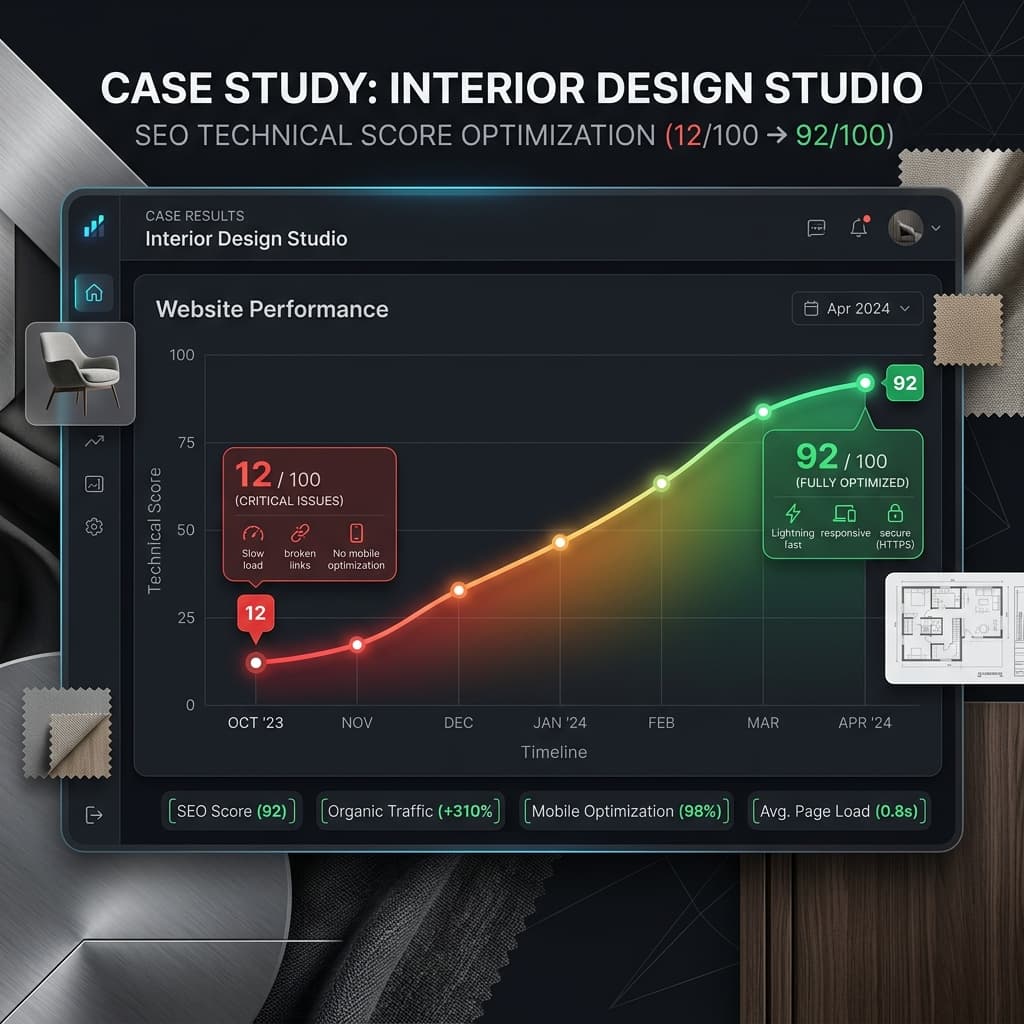
When an established luxury residential interior design firm came to us, their portfolio was visually stunning but their technical SEO health score sat at a dismal 12/100 on PageSpeed Insights.
By migrating their stack to Headless Next.js 16, restructuring heading hierarchy, implementing automated WebP compression, adding Schema.org LocalBusiness JSON-LD markup, and launching targeted location pages, their technical score surged to 92/100 within 30 days.
Within 90 days, the studio ranked on Page 1 of Google for high-intent terms like 'luxury residential interior designer Mumbai' and quadrupled qualified client enquiries.
14. Website Platform Benchmark (Next.js vs WP)
Evaluating web technologies for speed, security, and ranking potential.
Choosing the right web architecture directly impacts your Google rankings. Legacy site builders often suffer from server bloat and unoptimized visual assets, whereas modern Headless Next.js frameworks deliver sub-second performance.
| Platform | Speed / LCP | SEO Flexibility | Security | Best For |
|---|---|---|---|---|
| Headless Next.js 16 | ⭐⭐⭐⭐⭐ 0.8s (Ultra-Fast) | ⭐⭐⭐⭐⭐ Maximum (Custom SSR & Schema) | ⭐⭐⭐⭐⭐ Enterprise (Zero DB Risks) | High-End Luxury Studios & Architecture Agencies |
| WordPress + Elementor | ⭐⭐⭐ 2.8s - 4.5s (Laggy) | ⭐⭐⭐⭐ High (via Plugins) | ⭐⭐⭐ Moderate (Needs Constant Plugin Updates) | Standard Business Blogs & Small Portfolios |
| Squarespace | ⭐⭐ 3.8s - 6.0s (Slow) | ⭐⭐ Limited Customization | ⭐⭐⭐⭐ Closed Managed System | DIY Entry-Level Designers |
| Wix | ⭐⭐ 3.5s - 5.5s (Slow) | ⭐⭐ Moderate | ⭐⭐⭐⭐ Closed Managed System | Beginner Portfolios |
15. Organic SEO vs Paid Social Ads (ROI)
Evaluating long-term lead acquisition costs and compounding digital equity.
Meta Ads (Instagram & Facebook) provide immediate traffic, but the moment you pause ad spend, lead generation halts entirely.
Organic Search Engine Optimization compounds over time. Ranking #1 for high-intent keywords generates qualified design enquiries 24/7 without cost-per-click charges.
| Metric / Feature | Organic SEO Engine | Meta / Instagram Paid Ads | Google PPC Ads |
|---|---|---|---|
| Lead Continuity | 🚀 Continuous 24/7 Organic Traffic | Stops instantly when budget stops | Stops instantly when budget stops |
| Cost Per Lead (CPL) | 📉 Decreases over time | 📈 Increases as ad costs rise | High CPC bid competition |
| Client Intent Level | ⭐ Highest (Actively looking to hire) | Moderate (Passive feed browsing) | High |
| Long-Term ROI | 🏆 Exponential Compounding Equity | Linear / Pay-to-Play | Linear |
16. Content Publishing Strategy & Keyword Mapping
Structuring a topical cluster to build domain authority in interior design.
Publishing content randomly rarely yields top search rankings. Google rewards websites that demonstrate topical authority through structured pillar content and cluster articles.
Create a central master pillar page around 'Interior Design Services in [City]' and link to supporting sub-topic cluster articles like 'How Much Does Luxury Interior Design Cost in [City]?' and 'Top 10 Modern Villa Design Trends'.
17. Partnering with a Specialized Technical Agency
Combining luxury aesthetic execution with search engine dominance.
Generic marketing agencies rarely understand spatial design aesthetics, luxury client psychology, or architectural portfolio presentation.
Amfor Studio specializes strictly in Web Engineering & Technical SEO for Interior Designers & Architects building custom Next.js platforms that pair striking visuals with page-one Google rankings.
Is Your Website Losing Potential High-Ticket Clients?
A beautiful portfolio should attract admiration but it should also generate qualified client enquiries. If your website isn't appearing on Google when potential clients search for an interior designer, there are usually a handful of technical issues holding it back.
- ✓Technical SEO issues affecting rankings & indexing
- ✓Missing high-intent keywords your competitors are targeting
- ✓Page speed and mobile performance bottlenecks
- ✓Content opportunities to attract qualified design leads
- ✓Quick wins you can implement immediately
Frequently Asked Questions
Final Thoughts
Request your Free Interior Design SEO Audit today and discover what's stopping your website from ranking on page one of Google. No obligation. No sales pressure. Just actionable technical recommendations tailored to your studio.