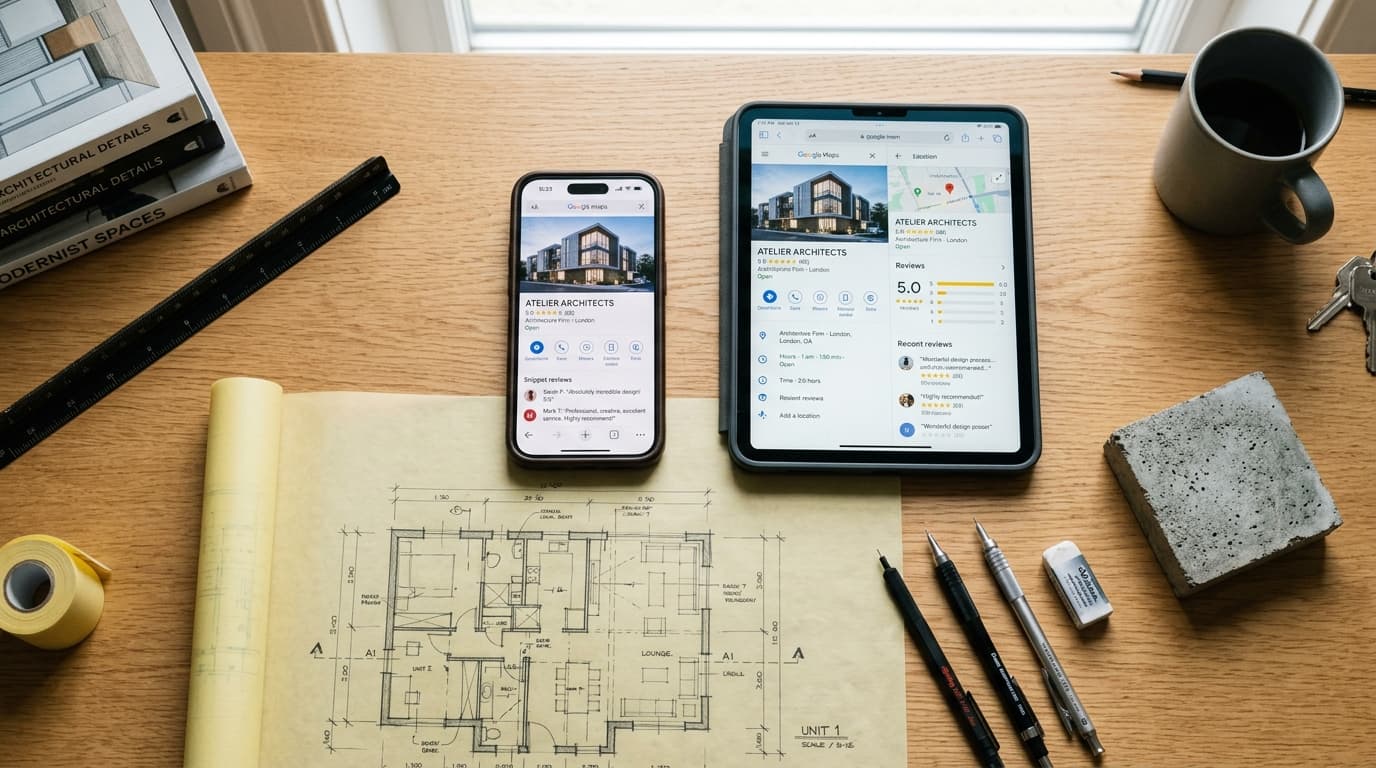
Google Business Profile (GBP) is the single most important local SEO asset for an architecture firm. It controls whether your studio appears on Google Maps and in local search results — and for most firms, it's where a potential client forms their very first impression of the practice.
Before a client visits your website, before they see your portfolio, and often before they've made any decision at all, they see your Google Business Profile in search results. A complete, well-maintained profile signals credibility. An abandoned or incomplete one signals the opposite.
This guide covers every aspect of GBP setup and optimization that matters for architecture firms — including the parts most firms skip after the initial setup.
(For the broader local SEO context, see Local SEO for Architects.)
Why GBP Matters More Than Most Architects Realize
Local search is significant. A large share of clients searching for an architect add a location to their query or use "near me" — and Google responds by showing the Local 3-Pack (the map with three highlighted businesses) before any organic results.
Being in that 3-pack is worth more than ranking #1 in organic results for most local queries. The map placement is more visually prominent, it shows star ratings, phone numbers, and distance — and it appears above the organic results on mobile.
An optimized GBP is the primary factor in getting into the Local 3-Pack. No other single action has a faster impact on local search visibility.
Step 1: Claim and Verify Your Profile
If your firm isn't already on Google Maps, start at business.google.com.
Search for your firm name first. Google may have auto-generated an unverified listing based on data from web directories. Claim it rather than creating a duplicate.
Verification options:
- Postcard: Google mails a code to your business address (standard method)
- Phone or email: Available for some businesses
- Video call: Google may offer live verification for some business types
- Instant verification: Sometimes available if your domain is verified in Google Search Console
After verification, you have full control over the listing. Before this, anyone can suggest edits that may be applied without your approval.
Step 2: Choose the Right Business Category
The primary category is the most important GBP signal for local ranking. Choose it carefully.
Correct primary categories for architects:
- Architect — the most specific and appropriate for most architecture firms
- Architectural Designer — for firms doing design work without full architectural licensing
Possible secondary categories (add relevant ones, not all of them):
- Interior Designer
- Landscape Architect
- Renovation Contractor (only if the firm directly oversees construction)
- Real Estate Developer (only if relevant)
Do not add categories that don't genuinely apply. Google uses category signals to determine search relevance. Over-categorizing with unrelated categories can dilute rather than broaden visibility.
Step 3: Write a Keyword-Rich Business Description
The GBP description (up to 750 characters) appears on your profile and is a legitimate place to include natural language that reflects what clients search for.
What to include:
- What type of architecture the firm specializes in (residential, commercial, sustainable)
- The primary city and region served
- Any distinctive specializations (heritage restoration, passive design, adaptive reuse)
- A brief statement of the firm's approach
Example:
"Amfor Studio is a Mumbai-based architecture and design studio specializing in residential architecture, commercial interiors, and sustainable building design. We work with homeowners, developers, and hospitality brands across Mumbai, Pune, and Goa — from bespoke private homes to hospitality and mixed-use developments. Every project begins with an understanding of the site, the client's way of living, and the local planning context."
What to avoid:
- Keyword lists ("best architect Mumbai luxury villa modern design")
- Generic statements ("We are passionate about great design")
- URLs (Google doesn't allow them in descriptions)
- Inaccurate service claims
Step 4: Keep NAP Exactly Consistent
NAP — Name, Address, Phone — must match exactly between your GBP and your website.
"Exactly" means:
- If your website lists "Ground Floor, 12 XYZ Road," your GBP should say the same — not "12 XYZ Road, Ground Floor"
- If you use "Amfor Studio" on your website, your GBP must be "Amfor Studio" — not "Amfor Studio India" or "Amfor Studio Pvt Ltd"
- The phone number format should be consistent
Google cross-references GBP data with website data to verify legitimacy. Inconsistencies are a trust signal problem that quietly suppresses local rankings.
NAP should also be consistent across all other directories — Houzz, ArchDaily, Archinect, and any local business directories where the firm appears.
Step 5: Upload Portfolio Photos Strategically
GBP allows photos across several categories. Architecture firms should use all of them.
Exterior photos: The office building or studio exterior — confirms the business exists at the stated address.
Interior photos: Studio workspace, meeting rooms, model/drawing areas.
Work photos: Project portfolio images — these are the most viewed photos on an architecture firm's GBP. Use 10–20 high-quality images from your best projects, including completed exteriors, key interiors, and details.
Team photos: Principal architects and key team members — humanizes the firm and builds trust.
Photo best practices:
- Minimum 720px on the short side
- Well-lit, professionally photographed where possible
- Add a location tag to project photos where the feature is available
- No text overlays, watermarks, or promotional graphics (these may be removed by Google)
Upload new photos regularly. Active profiles with recent photo additions rank better than stagnant ones. A monthly photo upload of one or two new project images is a simple, low-effort habit.
Step 6: Build Your Review Strategy
Reviews are the most trust-significant element of a GBP listing and a meaningful local ranking signal.
The ask: Build the review request into your project handover process. When a project completes, send a personal email to the client with a direct link to your GBP review form. A personal ask from the principal is far more effective than an automated email.
Responding to reviews: Respond to every review — positive and negative. For positive reviews, a brief, specific acknowledgment shows you read it. For negative reviews, respond calmly and professionally with a commitment to resolve the issue.
Timing: Ask for a review when the client's satisfaction is at its peak — at project completion, or shortly after they've moved in or occupied the space.
What not to do: Do not offer incentives for reviews (Google's terms prohibit it), do not ask employees or friends to leave reviews, and do not use a review generation service that creates fake reviews. Google detects and removes inauthentic reviews, and can penalize the listing.
A steady stream of genuine, specific reviews (mentioning the project type, location, and quality of service) carries more weight than a burst of generic five-star reviews.
Step 7: Post Updates Regularly
GBP allows you to publish short posts — updates, project completions, insights, and announcements — directly on your listing.
Posts appear in the profile and can appear in the local Knowledge Panel for branded searches. Regular posting signals an active business and gives Google fresh content to evaluate.
What to post:
- Project completion announcements (with a photo)
- Awards or recognition (if genuine)
- Practice updates (new principal, new office)
- Links to new blog content on your website
Post frequency: once a week is ideal; once a month is the minimum to maintain a "recently active" signal.
Posts expire after seven days for standard posts — they remain visible but marked as older. Only "Offer" and "Event" posts have expiry dates you set.
What Affects Google Maps Ranking for Architects
Three factors primarily determine where a firm appears in local search results:
Relevance: How well the GBP category, description, and website content match the search query. "Architect" + primary category + service description mentioning residential/commercial work.
Distance: How close the listed business address is to the searcher. This is a factor the firm can't control — but it's why a Mumbai firm should focus on Mumbai queries rather than trying to rank in Bangalore from a single Mumbai listing.
Prominence: How well-known and established the firm appears — based on review volume and rating, website authority, backlinks, and mentions in other directories and publications.
Improving all three: keep GBP complete and active (relevance + prominence), maintain a local address (distance), earn reviews and directory citations (prominence).
Common GBP Mistakes Architecture Firms Make
Claiming the profile and never updating it — the most common mistake. An inactive profile signals a dormant business.
Wrong primary category — choosing "General Contractor" or "Design Studio" instead of "Architect" misaligns the relevance signal.
Inconsistent NAP — different phone numbers, suite numbers, or name variations across the website and GBP.
No portfolio photos — the most-viewed element of an architecture GBP, left empty.
Not requesting reviews — waiting for clients to leave reviews unprompted. Most won't without a direct, personal ask.
Not responding to reviews — makes the profile feel unmanned.
Frequently Asked Questions
How important is Google Business Profile for architects?
It's the primary driver of local search visibility — specifically, whether your firm appears in the Google Maps 3-Pack for city-based searches. For most architecture firms, it's the highest-leverage single optimization action available.
What category should architects choose on Google Business Profile?
"Architect" is the correct primary category for most architecture firms. Secondary categories can include "Interior Designer" or "Landscape Architect" where genuinely applicable.
How often should architecture firms update their GBP?
At minimum, upload new project photos monthly and respond to reviews promptly. Publishing a post once or twice a month signals ongoing activity. More frequent updates generally produce better local rankings.
How do I get more Google reviews as an architect?
Ask at project handover — personally, by email, with a direct review link. A personal ask from the principal at the moment of highest client satisfaction is the most effective approach.
Does Google Business Profile affect my website's organic rankings?
Not directly. GBP influences local pack (map) rankings. Strong GBP signals can contribute to the overall trust signals Google associates with your domain, which may have an indirect effect on organic rankings.
Should a firm with two offices have two GBP listings?
Yes. Each office should have its own verified GBP listing with the correct local address, phone number, and city-specific photos and description.
Can I add portfolio images to Google Business Profile?
Yes — and you should. The "Work" or "Photos" section of GBP is specifically designed for this. Architecture project photos are among the most viewed elements on an architect's profile.
Get Your Architecture Firm's GBP Working Properly
Amfor Studio's local SEO engagements include a full Google Business Profile audit and optimization — category selection, description writing, photo strategy, and review process setup. Explore our full suite of SEO Services for Architects to learn how local search connects with technical SEO.
Get a free GBP audit for your architecture firm
See also: SEO Services for Architects | Local SEO for Architects | SEO for Architecture Firms in India | SEO Agency for Architects